- Jun 25
The Toddler Mom's Guide to Actually Good Kids' TV (And My Honest Thoughts on Cocomelon and Miss Rachel)
- Ashley Ventrice
- 0 comments
By Ashley Ventrice, Licensed Child Development Specialist
Not all kids' shows are created equal. And as a licensed Child Development Therapist, I have very strong feelings about what is going on on your child's screen — and I am here to share them freely, without apology, and with love.
I get this question constantly from toddler moms: "Okay but what should we actually be watching?" So today I'm breaking down six shows I genuinely love from a developmental standpoint, two more you probably haven't heard of but need on your radar, and then — yes — we're talking about Cocomelon and Miss Rachel.
I said what I said. Let's get into it.
---
What Makes a Toddler Show Actually Good?
Before we dive into the list, here's the framework I use as a Child Development Therapist when I evaluate kids' content. Ask yourself three questions about any show your toddler watches:
1. Does it move at a pace my child's brain can keep up with?
2. Does it show my child something true about feelings, relationships, or the world?
3. How does my child's body feel and behave after they watch it?
Those three questions will tell you everything. Keep them in your back pocket as you read through this list.
---
Show #1: Little Bear
Can we talk about Little Bear for a second? Because I feel like this show does not get nearly enough credit, and it is one of the most underrated gems in children's television.
Little Bear is an animated series based on the beloved children's book series by Else Holmelund Minarik, illustrated by Maurice Sendak — yes, the same Maurice Sendak who gave us Where the Wild Things Are. The show follows Little Bear, a sweet young bear, through gentle everyday adventures with his family and friends. There are no villains. No chase sequences. No dramatic music. Just a little bear living a little life and finding wonder in ordinary things.
And from a Child Development Specialist perspective? That is “exactly” what a toddler brain needs.
Here's what I love about Little Bear developmentally:
The pacing. This show is slow. Beautifully, intentionally slow — and I mean that as the highest possible compliment. The episodes give children's brains time to process what they're seeing and hearing before the next thing happens. There's no rapid-fire editing, no quick cuts designed to hold attention through constant novelty. Little Bear trusts children to sit with a moment — and that trust actually builds attention span rather than eroding it.
The language. Little Bear is rich with vocabulary and natural conversation. Characters speak in full sentences, have real back-and-forth exchanges, and express their feelings with words. For toddlers in the thick of language development, hearing that kind of paced, expressive language modeled consistently is like a language bath every single episode.
The emotional tone. Little Bear is warm and secure. The family relationships are loving and present. For toddlers whose nervous systems are still developing, watching content that is calm, safe, and warm actually supports nervous system regulation — instead of activating it.
The imagination. So much of Little Bear's world is driven by imaginative play and storytelling. He makes up adventures, pretends, creates. That's exactly the kind of thinking we want to be nurturing in young children.
Little Bear is an absolute gem. If you haven't put it on for your toddler yet — please do.
---
Show #2: Daniel Tiger's Neighborhood
My beloved. Where do I even begin.
Daniel Tiger's Neighborhood is produced by Fred Rogers Productions and is the animated sequel to Mister Rogers' Neighborhood. It follows Daniel Tiger, a 4-year-old tiger, through everyday experiences — starting a new school, managing anger, being disappointed, sharing, dealing with a new sibling. Each lesson is reinforced through a short, catchy song that children can actually remember and use in real life.
From a clinical perspective, this show is essentially a “social story” in television form. If you work in early childhood education or therapy, you know what a social story is — a narrative that walks a child through a specific situation, what to expect, how to feel, and what to do. Daniel Tiger does this in every single episode. It is therapeutic storytelling, and it is brilliant.
Now let's talk about the research — because this is where I get genuinely excited.
Studies show that children who watch Daniel Tiger's Neighborhood have “higher levels of empathy”, are better at recognizing emotions, and are more confident in social situations. That's not marketing language. That's peer-reviewed research.
Here's what I find even more remarkable: a UCLA study surveyed 150 teenagers between the ages of 13 and 16 who were toddlers when the show first aired. Researchers found that:
- 71% remembered feeling happy while watching the show
- 57% said their most memorable lessons were about understanding and managing emotions
- 21% specifically mentioned they still use calming techniques they learned from Daniel Tiger — as teenagers
They are “teenagers”. Still using what they learned from a cartoon tiger when they were three years old. Let that sink in.
The research also found that the benefits were strongest when parents watched with their children and talked about what was happening on screen. The combination of watching AND conversation produced the biggest increases in social skills — neither alone was enough.
So if you're already a Daniel Tiger household — keep watching with your kids. Ask them about what Daniel is feeling. Sing the songs together. You are doing something genuinely powerful for their development.
---
Show #3: Sofia the First
A princess show that actually has something real to say — and that combination is rarer than you'd think.
Sofia the First is a Disney Junior animated series about Sofia, a young girl whose mother marries a king and suddenly she goes from being a regular village girl to being a princess. The show follows her as she navigates this new world — learning what it actually means to be royalty, dealing with jealousy from her new stepsiblings, and figuring out how to use her magical amulet wisely.
What I love about Sofia from a developmental standpoint is that “kindness is genuinely at the center of every episode” — not just mentioned as a value, but actually demonstrated, wrestled with, and chosen in real circumstances where another choice would have been easier. Sofia makes mistakes. She chooses wrong sometimes. And then she figures out the right thing and does it anyway.
That is such a healthy model for young children. Not a perfect character who is always kind — a real character who is “learning” to be kind even when it's hard.
The show also does something really well that a lot of children's programming gets wrong: it shows “consequences”. When characters are unkind or dishonest or selfish, things don't work out for them. When Sofia chooses integrity, things do. Children are constantly building their internal model of how the social world works — and a show that consistently reinforces that kindness leads to connection is doing genuinely valuable character work.
The pacing is appropriate, the content is age-respectful, and honestly — the music is genuinely good. Sofia the First gets two thumbs up from this mama.
---
Show #4: Bluey
Oh, Bluey. The show that made the entire world fall in love with a cartoon Australian dog family and then cry unexpectedly in the finale.
If you have somehow not seen Bluey — first of all, where have you been — Bluey is an Australian animated series about Bluey, a six-year-old Blue Heeler puppy, her younger sister Bingo, and their parents Bandit and Chilli. Each seven-minute episode follows the family through everyday life, play, and the small but significant moments of childhood and parenting.
Here's what the research says about this one:
Researchers who analyzed all 150 episodes of Bluey across three seasons found that “nearly half of all episodes featured resilience as either a primary or secondary theme”. The show frequently portrays resilience-building behaviors aligned with established developmental frameworks, especially through family relationships and coping strategies.
Developmental scientists describe Bluey as exemplifying what years of child psychology research have made clear — that “children learn through play”. Bluey's rich dialogue encourages attentive listening and helps children connect language to ideas and emotions. And unlike many children's shows that rely on fast-paced editing and non-stop action, Bluey's soft colors, natural dialogue, and moderate pacing create a calming experience that fosters comprehension and emotional engagement.
But here's what I think is most powerful about Bluey — and it's what it models for the “parents” watching alongside their children.
Bandit and Chilli are not perfect parents. They get tired. They make mistakes. They sometimes just really need five minutes. And then they show up anyway. They get on the floor and play. They follow their children's lead. They repair when they get it wrong.
Watching Bluey is honestly like watching a masterclass in connected parenting — and it hits different when you're in the thick of toddlerhood and you needed to see that modeled.
Bluey earns every bit of its reputation. It is developmental gold.
---
Two More Child Development Therapist-Approved Shows You Need to Know About
Mister Rogers' Neighborhood (the original). I know — some of you are thinking "Ashley, that show is ancient." And yes, it first aired in 1968. And it is still one of the most developmentally sound pieces of children's media ever created. Fred Rogers was doing slow, intentional, emotion-first children's television before anyone had the research to explain why it worked. Every episode is built around a feeling. Every episode includes imagination, music, and a warm adult presence. It is timeless for a reason, it's available to stream, and your toddler will love it.
Puffin Rock. A nature documentary series for young children narrated by Chris O'Dowd, following a little puffin chick named Oona and her baby brother Baba on the island where they live. This show is visually stunning, narrated in the most gentle and engaging way, and introduces young children to the natural world with warmth and wonder. It is quiet. It is beautiful. It is the exact opposite of overstimulating. From a sensory and nervous system regulation perspective, it is one of the most genuinely calming shows I have ever seen for young children. If you have a toddler who tends toward dysregulation or sensory sensitivity — put Puffin Rock on and watch what happens.
---
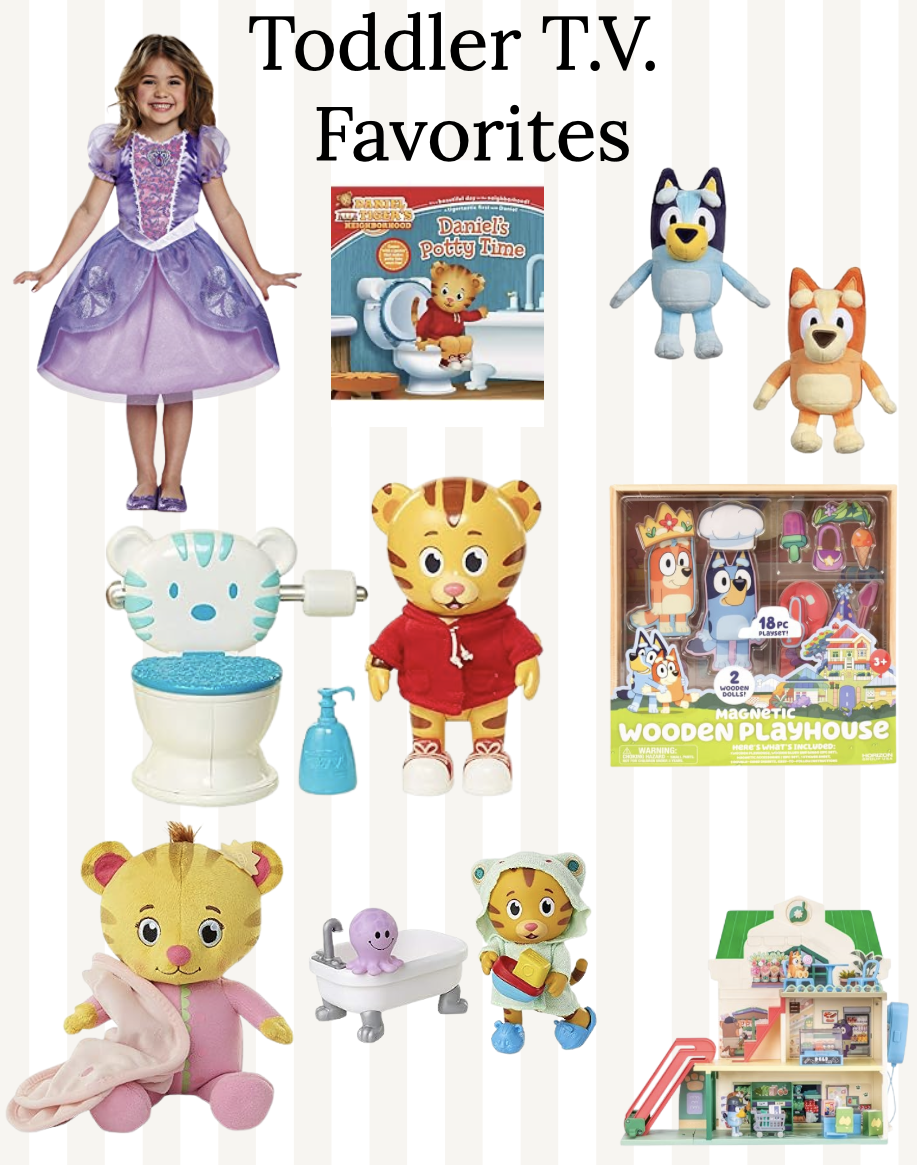
(Make your toddler's show come to life by using hands-on play)
Now. About Cocomelon and Miss Rachel.
I want to say first — I am about to be very honest and I am saying this with love. Genuine love. For your children and for you. Please hear me out.
Cocomelon
Cocomelon is one of the most-watched children's channels on YouTube and Netflix on the planet. Millions of toddlers watch it every day. And I understand why parents reach for it — it's colorful, it's musical, it's immediately engaging, and it keeps toddlers completely transfixed.
And that last part is exactly what concerns me as a Child Development Specialist
Cocomelon is designed to maximize engagement through “constant sensory stimulation”. The colors are extremely bright and saturated. The music is fast and repetitive. The editing cuts rapidly — the scene barely settles before something new is happening. Everything about the production is designed to hold a young child's attention through novelty and stimulation rather than through meaningful content or narrative.
The problem? A toddler's brain is not designed to process information at that pace. When content moves faster than a young brain can process, the brain essentially stops trying to process and just “reacts.” Over time, content that requires patience and slower engagement — like reading a book, listening to a story, or sitting through a quieter show — starts to feel unbearable because it can't compete with the dopamine hit of constant stimulation.
Some families report that their toddlers become extremely difficult to manage after Cocomelon — dysregulated, unable to transition, resistant to anything less stimulating. From a nervous system perspective, that makes complete developmental sense.
I am not here to shame any parent who has put on Cocomelon to get through a hard morning. I have been there. We have all been there. But if it's a daily staple and you're noticing your child is more dysregulated, more screen-dependent, or having harder transitions off screens — that is worth paying attention to.
Miss Rachel
Oh, Miss Rachel. Sweet, enthusiastic, genuinely well-intentioned Miss Rachel.
She has some genuinely good qualities. She uses speech therapy techniques. She encourages interaction. She pauses and waits for children to respond. From a language development standpoint, some of what she does is sound.
But. And this is a big but.
Miss Rachel is loud. Very high energy. Very stimulating visually and aurally. And the production has become significantly more intense over time — more colors, more excitement, more everything. For toddlers who are sensitive to sensory input — which, as a Child Development Specialist, I can tell you is a significant percentage of young children — Miss Rachel can actually be overstimulating in a way that works “against” regulation rather than supporting it.
I know she has an army. I respect the army. I am simply giving you my professional Child Development perspective.
---
The Bottom Line
The shows I love — Little Bear, Daniel Tiger, Sofia the First, Bluey, Mister Rogers, and Puffin Rock — all share the same set of characteristics that make them developmentally sound:
- They're slow enough for young brains to process
- They use rich, natural language
- They model real emotions and social situations in age-appropriate ways
- They build toward something — a lesson, a feeling, an understanding
- They calm the nervous system rather than activate it
- They respect the intelligence and emotional capacity of young children
You are not just choosing entertainment when you choose what your toddler watches. You are choosing the environment your child's developing brain is going to spend time in.
And you deserve to make that choice with real information.
---
Ashley Ventrice is a licensed Child Development Therapist, former childcare center owner, and host of The Ashley Ventrice Show podcast. She helps toddler moms understand child development so they can feel confident and stop second-guessing everything. Follow her at @ashleyventriceco.
Want to hear the full episode? Listen to The Ashley Ventrice Show wherever you get your podcasts.